The studio, transformed into a gallery.
Pixels2GenAI is an exhibition by software developers creating computer art. The works on view use equations, algorithms, and AI models to generate images and installations — exploring the space between hand-programmed images, the aesthetics of mathematical rules, and AI as an art-making tool.
At the end of March 2026, the office of IT studio Academis transformed into a gallery for two days — an opening evening for invited guests, then a day open to the public.
Exhibition I · March 27, 2026.
A one-day group show co-organised with Academis · Kristian Rother. Six artists. Printed work on the walls; code-driven installations on screens and projection.
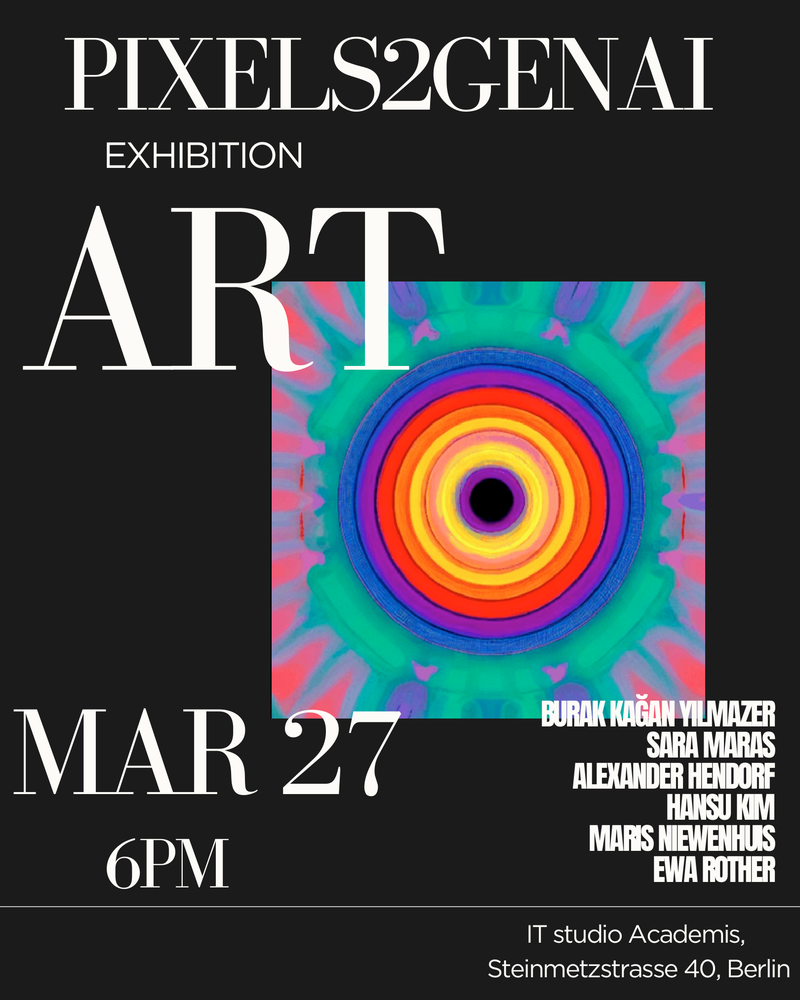
Six artists, one office, three days.
The exhibition opened on March 27 at 6pm for press and invited guests, and remained open for the general public on March 28 from 10am to 4pm. The works moved between two registers: printed pieces hung as objects, and code-driven installations running live on screens and projection.
Artists · six on view.
Six software developers, working across hand-programmed images, the aesthetics of mathematical rules, and AI as an art-making tool.
Plates · printed works.
4 series across two artists — 13 prints in all. Click any plate to enlarge.
Array Zero
Creation from nothing, in four NumPy operations.
Tectonic Threshold
Activation functions rendered as geological landscapes.
Orbit Sediment
Strange attractors displaced by turbulent noise fields.
Works by Sara Maras, Alexander Hendorf, Hansu Kim, and Ewa Rother were also on view during the exhibition and will be added once consent for online reproduction is collected from each artist.
Animated · installations on view.
Code-driven pieces that ran live during the exhibition. Two play here as looping captures; Dissolution is a live-only webcam piece whose capture is still pending. Each card links to its source repository.
Neural-Mycelium · metabolic rate
GPU-thermal-driven slime-mold simulation · live150,000 digital organisms deposit luminous trails that branch like fungal mycelium — Jones' (2010) Physarum sense-rotate-deposit model over a Hebbian network. Every parameter answers to the host machine's live vital signs: GPU temperature widens the sensory angle from 22° to 67°, CPU load extends sensing distance, power draw intensifies the deposits. The machine renders its own metabolic state as visible growth.
Selection Pressure · emergent flocking
Reynolds boid model + tournament-selection evolutionary algorithm · liveStars swarm under Craig Reynolds' 1987 boid rules — separation, alignment, cohesion — while black holes prowl as predators, bending light and consuming any star that drifts too close. An evolutionary algorithm runs beneath: survivors pass their behavioural weights to the next generation. The swarm learns by losing members.
Dissolution · noise → portrait
DDPM forward process + ControlNet · live webcamA webcam feed runs through MediaPipe face, hand, and pose tracking, Canny edges, then ControlNet-guided Stable Diffusion trained on anime. The DDPM forward process dissolves it — x_t = √(ᾱ)·image + √(1−ᾱ)·noise — until self becomes drawing, drawing becomes noise, and noise becomes self. Built from curriculum modules 12.3.2 (ControlNet) and 11.2.3 (face detection).
Documents.
The poster and printed materials produced for the exhibition.
Co-organised with Academis.
The exhibition was run jointly with Kristian Rother and Academis, who provided the venue at Steinmetzstrasse 40 and the curatorial framing that connected the works on view.
The exhibition is part of the wider Pixels2GenAI project — a Master's thesis exploring how learners move from the basics of pixel manipulation to generative AI. The works shown here are produced by artists working independently; the project provides the shared frame.