Pixels2GenAI
MA Thesis · Design-Based Research · Cycle ii · 2026

Pixels to generative AI,
one continuous thread.

A free, open-source curriculum that takes you from a single array element to building, training, and reasoning about modern generative models — across fifteen progressive modules, each producing a visual artifact.

Modules15 + Capstone
MethodDBR · 3 cycles
Theory / Practice40 / 60
LicenseFree · MIT + CC-BY
Fig. 0 The journey object · M 01 → M 12
F · front · 0°
M 01 · Pixelsf 1 / 6
R · right · 90°
M 01 · Pixelsf 2 / 6
B · back · 180°
M 01 · Pixelsf 3 / 6
L · left · 270°
M 01 · Pixelsf 4 / 6
U · top · 90°
M 01 · Pixelsf 5 / 6
D · bottom · -90°
M 01 · Pixelsf 6 / 6
Pixels → GenAI0%
PIXELS · M 01GENAI · M 12
Drag the master slider to traverse the curriculum.
§ 1 · Curriculum

From pixels, to inference.

The curriculum is composed in three paths. Each path holds a small set of modules; each module holds three to seven sub-topics; each sub-topic holds a handful of lessons. It's linear by design, but experienced programmers can start at a later cycle. Open a module to see its anatomy.

Path I

Foundations.

Pixels, geometry, recursion, simulation. NumPy + PIL only — no networks. Build visual intuition first.

6 modules 70 lessons
Path II

Machine Learning.

Procedural generation, classical ML, animation, intro neural networks, real-time. The bridge from arrays to inference.

6 modules 81 lessons
Path III

Generative AI.

GANs, VAEs, diffusion, language models, integration, capstone. Generative AI in practice.

4 modules 42 lessons
§ 2 · Workshops

The curriculum, in a single day.

A recurring one-day workshop that condenses the curriculum into a single sitting. The archive begins with the first cohort below; the next workshop is in planning.

Pixels2GenAI · Workshop archive ▌ 1 completed · 1 in planning
01 ✓ Completed Workshop · one-day intensive Berlin · February 12, 2026

01 · One-day intensive.

Six modules, one sitting, in Berlin. The first cohort produced the data reported in /research.

Date
February 12, 2026 · 9:00–16:00
Where
Berlin · with Academis
Cohort
9 participants · one day · pixel → diffusion
Modules
1.1.1RGB Basics1.2.2Cellular Automata3.4.1Convolution4.1.1Fractal Square9.1.1Perceptron12.3.1DDPM Basics
Outcome
Every participant improved · scores roughly tripled (3.6 → 12.1 / 24).
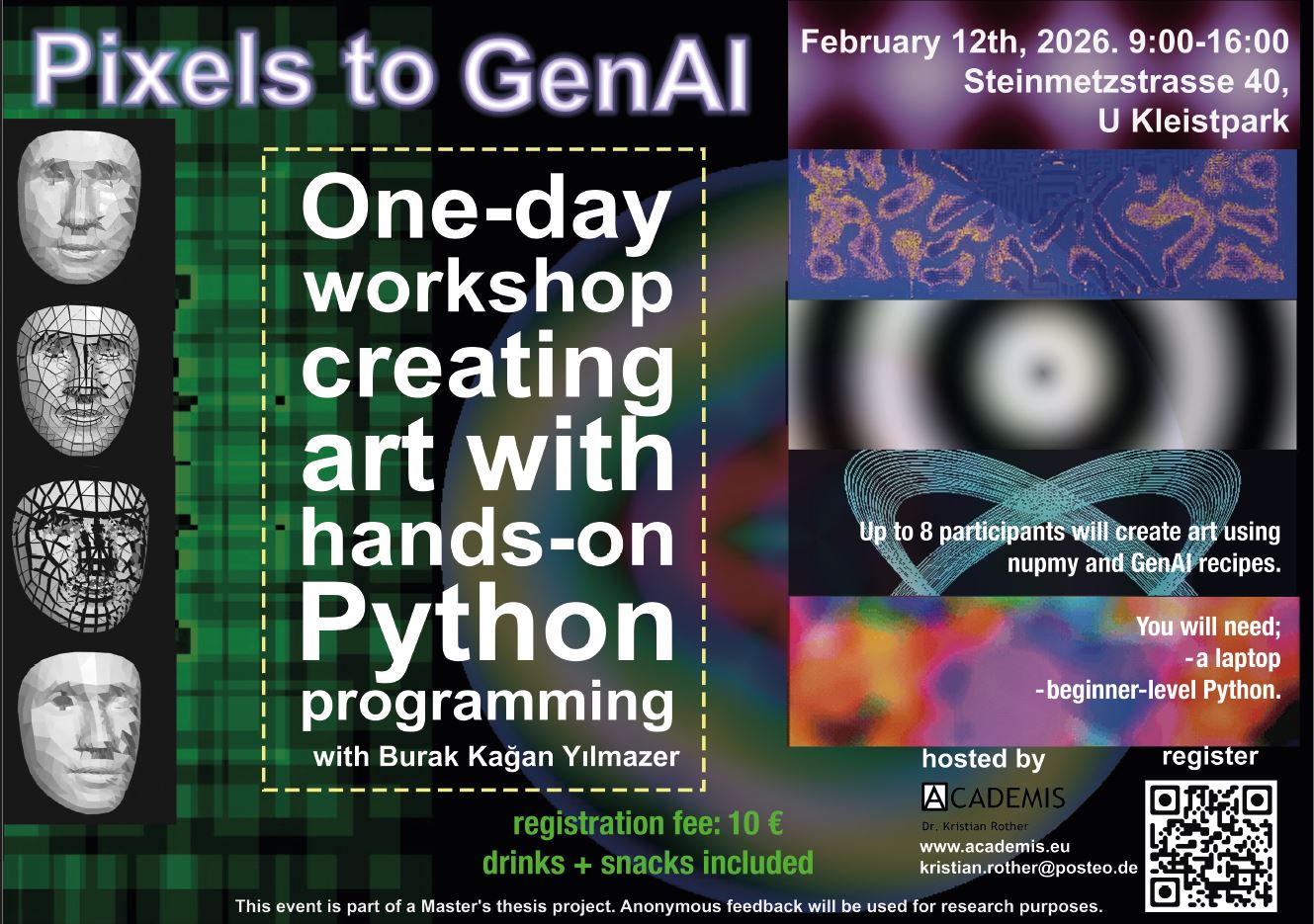
Printed poster announcing Workshop 01 · Berlin · February 12, 2026.
Poster · Berlin
02 ▌ In planning Workshop · registration open TBA · TBA

02 · Next in the program.

The next workshop in the recurring program — one day with Academis, same shape as 01. Registration of interest is open now; date and venue follow.

Date
TBA
Where
TBA · with Academis
Cohort
Capacity TBA · one day
Modules
TBA
Poster · 02 Designed once the date and venue land.
Register interest → No newsletter · single mail per workshop
§ 3 · Exhibition

The studio, transformed into a gallery.

A group exhibition co-organised with Kristian Rother and Academis: six artists working across printed and code-driven pieces, several built directly from curriculum modules. The archive begins below; the next exhibition is not yet scheduled.

Pixels2GenAI · Exhibition archive ▌ 01 completed
01 ✓ Completed Group show · 6 artists Berlin · March 27, 2026

01 · The first group show.

Over two days, 6 artists turned the IT studio Academis office in Schöneberg into a gallery: printed works on the walls, code-driven installations on screens and projection. Several of the pieces grew directly out of curriculum modules — equations, algorithms, and generative models, arranged as objects you could walk between.

Opening
March 27 · 18:00 · invited guests
Public
March 28 · 10:00–16:00
Where
IT studio Academis · Steinmetzstrasse 40 · U Kleistpark · Berlin
Artists
Burak Kağan Yılmazer, Sara Maras, Alexander Hendorf, Hansu Kim, Maris Niewenhuis, Ewa Rother
Format
Prints + animated installations · admission free
Co-organised
With Academis · Kristian Rother
Plates · 5 of 8 works Curated · prints by Burak Kağan Yılmazer
See the full exhibition → Hear about the next show → Next show unscheduled · one mail when it is
§ 4 · Research

Five questions, three cycles.

The curriculum is the empirical artifact of a design-based research thesis. Each cycle iterates on the same five questions; this is the third.

RQ 1

Framework design

What pedagogical principles and design patterns effectively scaffold learning progressions from basic array manipulation to generative AI in creative contexts?

RQ 2

Cognitive load

How can complex technical concepts be decomposed and sequenced to maintain optimal cognitive load while building toward advanced applications?

RQ 3

Integration paths

What strategies effectively integrate real-time systems with progressive AI learning, and at what points in the curriculum should these integrations occur?

RQ 4

Assessment

How can learning outcomes in creative AI education be assessed across technical proficiency, creative expression, and conceptual understanding?

RQ 5

Transfer

To what extent do learners successfully transfer foundational computational concepts to novel creative AI contexts, and what factors facilitate this transfer?

Foundations Modules 00 – 05
Machine Learning Modules 06 – 11
Generative AI Modules 12 – 15
Read the full study → DBR pilot · n = 9 · Cohen's d = 1.615 · ρ = −0.857
§ Announcements · Workshops & exhibitions

Hear about the next one.

Events are announced once a date and a venue are confirmed — one mail per event, no newsletter. We write only when there is something to announce.