The curriculum, in a room.
A recurring one-day workshop that condenses the curriculum into a single sitting. The first cohort produced the data behind § Research; the next is in planning.
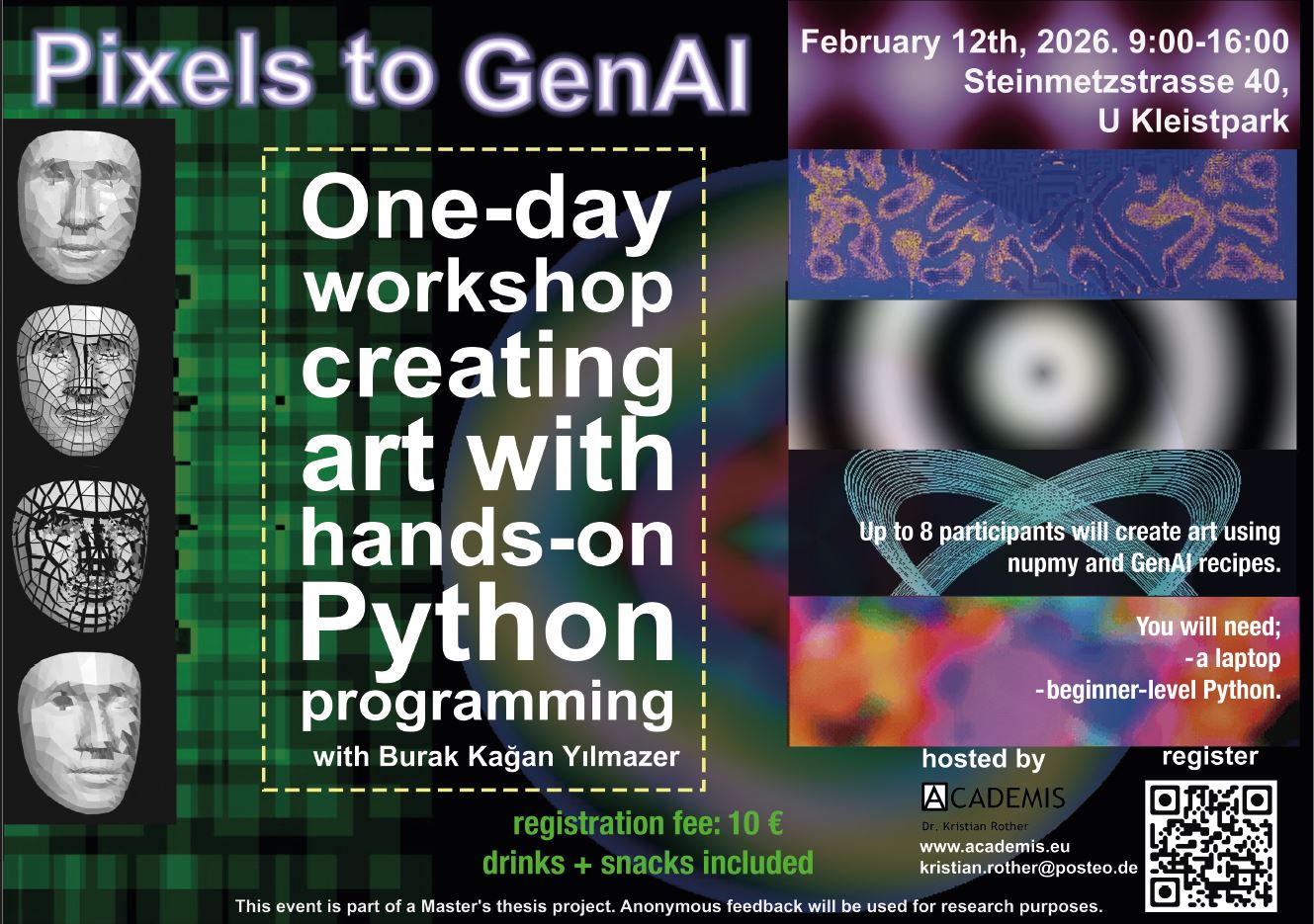
Workshop i · February 12, 2026.
A one-day intensive in Berlin. Nine participants moved from a single NumPy array to generating images with a small diffusion model — across six lessons of the curriculum.
Six modules, in a single sitting.
Participants arrived with laptops and beginner-level Python. Six lessons followed in sequence: RGB as array, cellular automata, convolution, fractal squares, a perceptron, and a small DDPM. The transformation lesson was the hardest — NASA-TLX scores peaked there — and the fractal lesson produced the most visible artifacts: nine self-similar plaids, no two alike, shown below. The full set of findings is in /research.
- M 1.1.1RGB Basics
- M 1.2.2Cellular Automata
- M 3.4.1Convolution
- M 4.1.1Fractal Square
- M 9.1.1Perceptron
- M 12.3.1DDPM Basics
Participant outputs · fractal square.
Outputs from Module 4.1.1 · Fractal Square. Each participant arrived at a different self-similar pattern from the same recipe.
Module 4.1.1 is a recursive function with two free parameters; the cohort's spread across those parameters is what the grid shows. Click any tile to enlarge. Outputs reproduced with consent.
What the cohort moved.
Full method, instruments, and limitations in /research.
Workshop ii in planning
Date and venue TBA. One announcement email when it's confirmed.
Co-organised with Academis.
Workshops are run jointly with Kristian Rother and Academis, who provides the venue, the cohort recruitment, and the facilitation experience that turns a draft curriculum into a teachable one. The thesis behind the curriculum is supervised independently; the workshop program is shared work.
Workshops are part of a Master's thesis project. Anonymous feedback collected during sessions is used for research purposes under the terms participants consent to at sign-in.